THE 30A TRIBUNE PODCAST
Rather Listen to the News?
Join Walter P. Shore, The 30A Tribune’s distinguished news anchor, for the audio edition of this story. Five minutes of coastal absurdity, delivered with a perfectly straight face.
SOUTH WALTON, FLORIDA — As Walton County crews work to clear hurricane debris, restore normal operations, and remove fallen trees from public roadways, a growing number of 30A homeowners are demanding a second, far more urgent phase of the recovery effort: making everything look expensive again.
The controversy began shortly after the storm, when several coastal residents discovered that hurricanes do not distinguish between multimillion-dollar beachfront estates, modest inland homes, or houses with custom Italian limestone driveways.
For some, the realization was devastating.
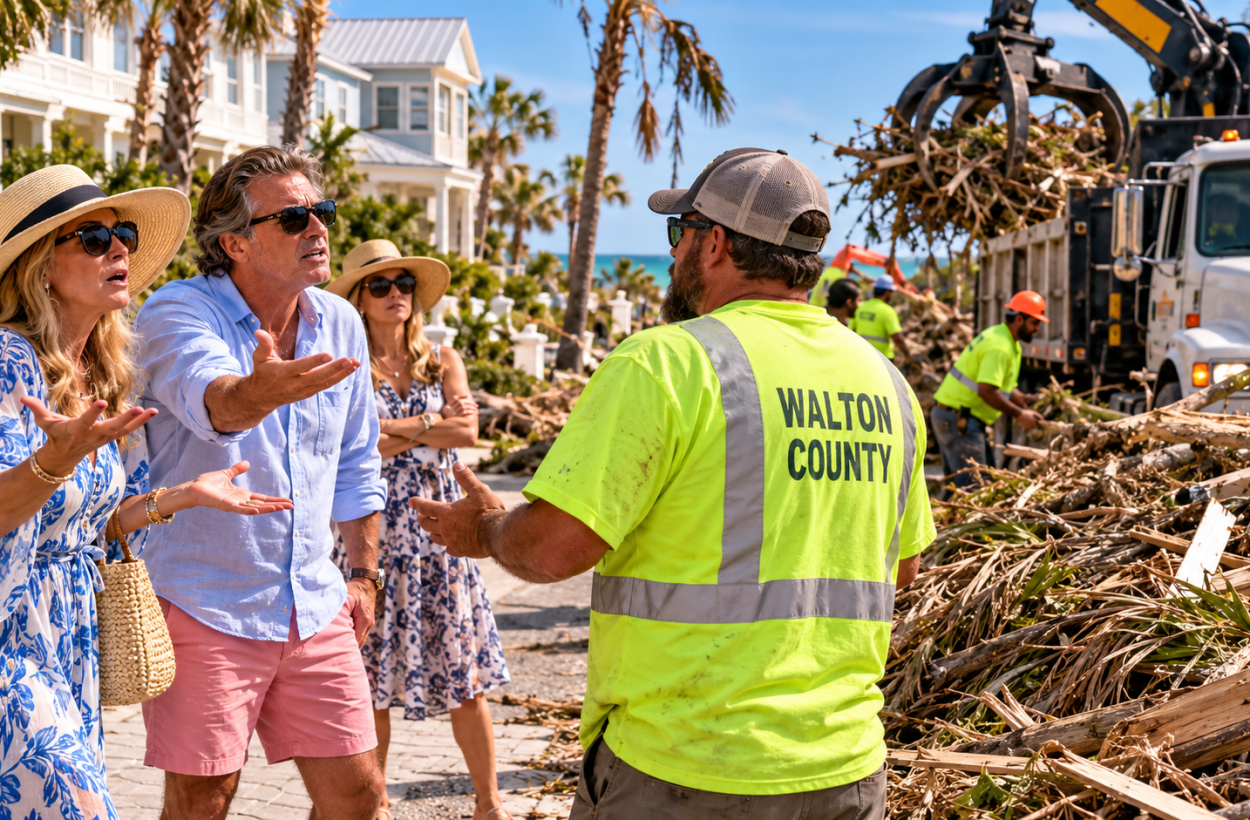
“I understand that storms happen,” said one visibly distressed homeowner, standing beside a pile of fallen palm fronds. “But nobody explained that the debris would be visible from my outdoor kitchen.”
The homeowner, whose property reportedly features seven separate outdoor entertaining areas and a refrigerator exclusively for sparkling water, said the county’s response has been “deeply disappointing from a lifestyle perspective.”
“We pay an extraordinary amount to live here,” she continued. “I simply assumed the wind would understand that.”
Homeowners Question Why County Didn’t Schedule Hurricane Cleanup Before the Hurricane
The first formal complaints began arriving almost immediately after the weather cleared.
According to residents familiar with the situation, one neighborhood submitted a strongly worded request asking why Walton County had not arranged to remove all fallen trees before they actually fell.
“This is basic preparation,” insisted a homeowner who maintains three separate hurricane insurance policies but has never personally operated a chainsaw. “We knew a storm was coming. Why weren’t those branches already gone?”
County personnel reportedly attempted to explain that identifying which trees would fall before the storm was not an available public service.
The explanation was described by several residents as “surprisingly negative.”
One property owner suggested that the county should employ a dedicated meteorologist with experience in luxury landscaping.
“If a resort can anticipate when I need fresh towels, surely local government can anticipate a falling oak tree,” he argued.

County Officials Explain That Fallen Trees Must Be Collected, Not Emotionally Processed
At a tense discussion concerning storm recovery priorities, county cleanup personnel attempted to outline the practical challenges of clearing roads, collecting vegetation, and managing a large volume of debris.
Residents repeatedly interrupted with questions about aesthetics.
One homeowner asked whether debris trucks could be painted in “a softer coastal palette.”
Another requested that county workers wear linen uniforms.
A third wanted to know whether the trucks could operate silently because the sound of diesel engines was interfering with her morning manifestation routine.
The meeting reportedly reached its lowest point when a homeowner requested that workers temporarily relocate a fallen tree to a neighboring property until it could be removed.
“The problem isn’t necessarily the tree,” she explained. “It’s where the tree is being seen.”
A cleanup coordinator, after taking several long breaths, reportedly responded that county trucks were designed to remove storm debris, not participate in interior design.
“We are trying to reopen roads. They are trying to reopen their outdoor entertaining season.”
The remark was reportedly followed by several seconds of silence, during which a homeowner quietly asked whether the county had considered offering valet debris pickup.
The Emergency Homeowner Association Meeting
Along Scenic Highway 30A, neighborhood associations quickly organized emergency meetings to address what several residents referred to as “the visual aftermath.”
One association circulated a proposed post-hurricane appearance policy that would require fallen branches to be arranged in tasteful groupings until county crews could arrive.
Under the proposal, branches would be stacked with their leaves facing outward, exposed roots would be screened from public view, and any fallen tree taller than six feet would require temporary architectural approval.
One subdivision reportedly proposed adding “earth-tone debris screens” to prevent vacation rental guests from realizing that severe weather had occurred.
“Our guests come here for relaxation,” said a property manager. “They didn’t pay premium rates to look at what appears to be an unsupervised natural disaster.”
Several owners suggested that storm debris should be removed during overnight hours to avoid disrupting sunset photographs.
Another requested that county cleanup vehicles not appear in the background of vacation rental listing pictures.
Officials explained that removing debris generally requires vehicles to physically be present near the debris.
This response was met with visible frustration.
Some Residents Demand Priority Cleanup Based on Home Values
Perhaps the most controversial proposal involved a suggested countywide cleanup priority system based on property value.
Under the plan, homes valued above $3 million would receive immediate attention, followed by homes valued between $1 million and $3 million, with remaining properties scheduled “when circumstances permit.”
“It’s not about being better than anyone,” explained one supporter of the proposal. “It’s about recognizing that some driveways cost more than other people’s entire houses.”
Another resident suggested establishing a special emergency debris hotline for homeowners whose outdoor furniture exceeded $20,000 in value.
“I lost two decorative planters,” he said. “Those planters were imported. I don’t think the county understands the international implications.”
When asked how the proposed system would address fallen trees blocking emergency access routes, the group suggested that emergency vehicles could simply take alternative roads through less expensive neighborhoods.
County personnel reportedly declined to pursue the idea.
A homeowner then asked if that decision could be appealed.
Walton County Cleanup Crews Discover Their Most Dangerous Obstacle: People With Clipboards
For county workers, the recovery effort has involved demanding physical labor, long hours, and the increasingly complicated task of explaining basic storm cleanup procedures to residents armed with property surveys and landscaping invoices.
One cleanup crew reportedly spent nearly twenty minutes listening to a resident explain that a fallen palm tree should be classified as “architectural vegetation” rather than yard waste.
The resident argued that the tree had been professionally installed at significant expense and therefore deserved a more dignified removal process.
Another homeowner asked whether crews could document the tree’s departure with professional photography.
“It was part of the original landscape vision,” she said. “We’d like to honor that.”
The workers reportedly loaded the tree into the truck anyway.
No ceremony was held.

Alys Beach, Rosemary Beach, and Seaside Residents Disagree Over Acceptable Debris Colors
Although homeowners throughout the 30A corridor generally agree that storm cleanup is important, opinions remain deeply divided over how the cleanup should look.
In Alys Beach, one resident proposed that debris temporarily stored near white architectural walls should be painted white to preserve neighborhood consistency.
Elsewhere along 30A, another homeowner insisted that storm debris should be limited to approved coastal colors, including sea-glass green, driftwood beige, and “weathered oyster.”
Branches described as “aggressively brown” would be prohibited.
A group of Seaside vacation homeowners reportedly suggested that county crews install decorative signs reading “Curated Coastal Recovery” beside large debris piles.
The signs would provide reassurance to visitors that the mess was intentional.
One resident proposed turning the debris into a temporary art installation, charging admission, and donating a small percentage of proceeds toward cleanup efforts.
“People pay to experience authenticity,” she explained. “This is an opportunity to monetize resilience.”
Officials reportedly responded that fallen trees were already sufficiently authentic and did not require branding.
Grayton Beach Residents Offer Different Solution: Just Bring a Chainsaw
While some residents debated landscaping aesthetics, a separate group of locals reportedly expressed confusion over the controversy.
One longtime Grayton Beach resident, observing the escalating complaints from a folding chair beside his pickup truck, summarized the issue in four words.
“It’s a damn hurricane.”
He then returned to drinking coffee.
When asked whether he believed county officials should prioritize the removal of fallen palm fronds blocking views from outdoor kitchens, he looked toward the interviewer for several seconds.
“You got a chainsaw?”
The response was not included in the neighborhood association’s official recommendations.
Other longtime residents expressed similar bewilderment at the idea that storm recovery should be coordinated around vacation rental photography schedules.
“We’ve always cleaned up after storms,” said another local. “You move the branches, help your neighbors, and wait for the county to get to the big stuff.”
He paused before adding, “Now apparently we need a committee to decide whether the leaves match the shutters.”
Emergency Meeting Turns Heated After Officials Mention North Walton
The debate took an unexpected turn when county officials reminded residents that hurricane recovery also involves communities outside the immediate 30A corridor.
The statement reportedly caused considerable confusion.
“Outside 30A?” asked one homeowner. “You mean the airport?”
Another wanted to know why county resources would be directed toward inland areas when coastal properties contribute so much to the local real estate economy.
Officials explained that Walton County extends well beyond the beach communities and that residents throughout the county are entitled to public services.
Several attendees appeared visibly uncomfortable.
“I completely support helping everyone,” one resident said. “But surely we could finish the scenic parts first.”
When the discussion turned to DeFuniak Springs, one homeowner reportedly asked whether the community had recently been annexed.
A county employee was seen slowly removing his glasses and placing them on the table.
The meeting then took a fifteen-minute recess.
Residents Propose New FEMA Category: Aesthetic Distress
With recovery continuing, some homeowners have begun advocating for an entirely new category of post-hurricane assistance.
They are calling it Aesthetic Distress.
Under the proposal, residents would be eligible for emergency relief if storm damage substantially reduced the visual appeal of outdoor entertaining areas, swimming pool views, or Instagram content.
Suggested qualifying conditions include:
- A palm tree leaning more than fifteen degrees away from its original landscape design.
- Visible debris within fifty feet of a professionally staged outdoor dining table.
- A debris removal truck appearing in a sunset photograph.
- Unexpected exposure to plywood, tarps, or unpainted construction materials.
- A vacation rental guest using the phrase “storm damage” in an online review.
- Any situation requiring a homeowner to personally touch a rake.
One supporter of the proposal emphasized that emotional harm should not be underestimated.
“People don’t realize how traumatic it can be to look out at the Gulf and see a blue tarp in your peripheral vision.”
She added that the situation had forced her family to temporarily use their indoor dining room.
“We haven’t had to do that since Thanksgiving.”
County Workers Asked Whether Debris Can Be Removed by Drone
In another proposal, homeowners suggested replacing traditional debris collection with a fleet of silent, aesthetically pleasing drones.
The drones would lift fallen trees from residential properties without blocking roadways or disturbing outdoor yoga sessions.
Residents proposed naming the service “Airbnb Recovery Concierge.”
When workers questioned whether small drones could lift several tons of storm-damaged timber, one homeowner recommended using larger drones.
“Technology is advancing every day,” he explained. “My refrigerator tells me when the oat milk is low. Surely there’s something that can pick up a tree.”
County workers reportedly continued using trucks.
Local Realtors Concerned That Debris May Be Reflected in Listing Photos
The storm recovery debate has also reached the real estate community, where some property owners fear that visible hurricane damage could undermine carefully crafted descriptions of the area’s coastal lifestyle.
One seller reportedly requested that a fallen tree be described in the property listing as a “rare natural architectural feature.”
Another suggested that temporary debris piles be marketed as environmentally conscious landscaping.
“Instead of saying storm damage, we could say the property offers an evolving organic landscape experience,” the homeowner proposed.
A vacation rental owner reportedly changed the description of a blocked driveway to “private vehicle-free arrival environment.”
The county has not indicated whether any of these descriptions would speed up debris removal.
Walton County’s Final Message: Please Stop Rearranging the Debris
As crews continue their work, county cleanup personnel have reportedly issued one particularly important request: residents should stop rearranging fallen branches into decorative piles immediately before collection trucks arrive.
Workers say carefully constructed debris sculptures have added unnecessary complications to an already demanding process.
One crew reportedly encountered a pile of palm fronds arranged into the shape of a sea turtle.
Another found storm debris tied together with expensive nautical rope and labeled “Please preserve arrangement.”
A third homeowner requested that his pile be collected last because he had invited friends over to see it.
County workers declined to comment on whether storm debris should be considered an acceptable centerpiece for a cocktail party.
Meanwhile, neighborhood association leaders continue discussing a possible countywide Hurricane Recovery Aesthetics Summit, complete with sponsored refreshments, coordinated resort wear, and a keynote presentation titled “Restoring the 30A Experience.”
The event is expected to conclude with a ribbon-cutting ceremony for the first successfully cleared decorative driveway.
Recovery Continues, With or Without a Color Palette
Despite the controversy, debris collection efforts continue, and residents throughout Walton County are gradually returning to normal routines.
For many, that means cleaning yards, checking on neighbors, repairing damage, and waiting patiently as crews work through the aftermath.
For others, it means submitting a fourth formal request asking whether the county can remove debris before their Saturday sunset dinner party.
One homeowner, standing beside a collection of fallen branches carefully arranged behind a decorative privacy screen, offered a final assessment of the situation.
“I love 30A. It’s paradise. But the county really needs to understand something.”
She paused, adjusting her designer sunglasses.
“Paradise is supposed to come with maintenance.”
At press time, a county employee was reportedly sitting alone in his truck, staring silently through the windshield while reconsidering every career decision that had brought him to this moment.
Outside, a homeowner knocked on the driver’s window.
She wanted to know if the truck came in beige.
Disclaimer: This article is satire. The conversations, homeowner complaints, government proposals, statements, and incidents described are fictional and written for entertainment. No actual Walton County official, homeowner, or business is being accused of making these statements or taking these actions. The accompanying photographs are real images supplied for illustrative use and do not document the invented conversations or events in this story. The companion podcast is narrated using an AI-generated voice representing the fictional news anchor Walter P. Shore.